Japan and South Korea Stocks Surge, Chip Stocks Ignite Semiconductor Boom
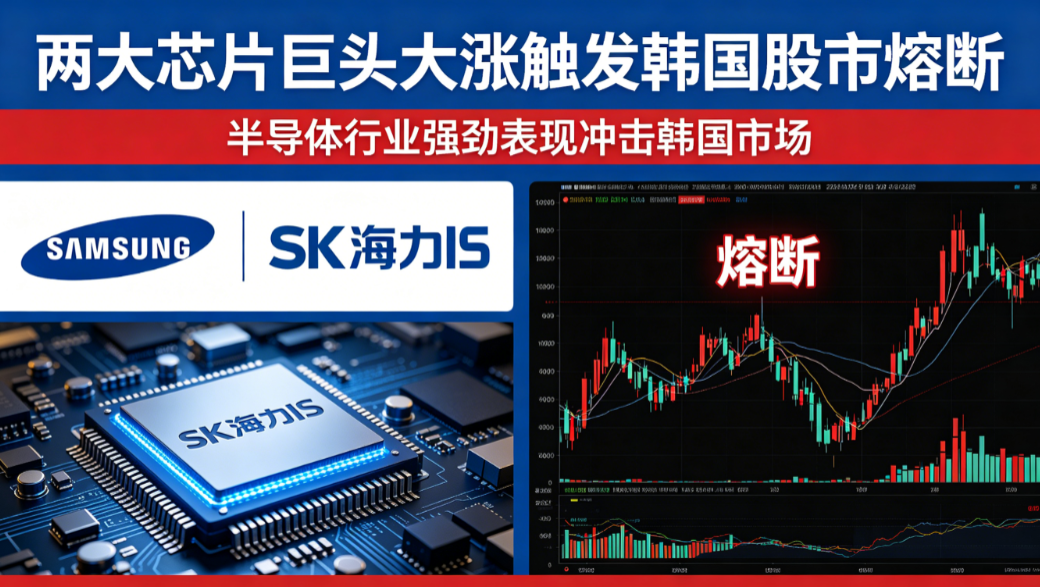
Japan and South Korea Stocks Surge: Chip Stocks Ignite New Chapter in Global Semiconductor Boom
Keywords
Japan & Korea Stocks, Chip Stocks, SK Hynix, Samsung Electronics, Micron Technology, AI Storage, Circuit Breaker, Semiconductor Boom
Introduction
On June 25, 2024, Asian financial markets saw a strong rally. Japan and South Korea's major indexes opened sharply higher, with South Korea's KOSPI at one point surging 5.51%, even triggering the KRX circuit breaker. This rare market move was not due to a sudden shift in macro policy, but a chain reaction sparked by a 'chip.' After US memory giant Micron Technology reported far better-than-expected quarterly results, global semiconductor sentiment instantly boiled over, with South Korea's two chip giants SK Hynix and Samsung Electronics surging on the news, leading a collective rally in Japan and South Korean stocks. This article will deeply analyze the driving factors behind this rally from three dimensions: market performance, company dynamics, and industry logic, and look ahead to the semiconductor industry's outlook.
1. Japan and South Korea Stock Market Strong Explosion: Data and Circuit Breaker Mechanism Explained
On the morning of June 25, Japan and South Korean stocks showed strong upward momentum. As of 8:06 Beijing time, the Nikkei 225 was up 2.32%, and the KOSPI surged 5.51%. Particularly striking, when KOSPI200 index futures hit the 5% upper limit, the KRX promptly activated the circuit breaker mechanism, suspending program trading for five minutes. This is a rare circuit breaker event in the Korean market this year, vividly reflecting the intensity of capital inflows.
The circuit breaker is designed to prevent irrational fluctuations from extreme sentiment. When KOSPI200 futures rise 5% in a single day, the exchange proactively suspends program trading for five minutes to give the market and investors time to calm down. This circuit breaker occurred shortly after the market opened, indicating that a large amount of buying concentrated in the Korean index futures market in a very short time, driven by strong bullish expectations for the semiconductor sector.
Meanwhile, the Japanese stock market also benefited from the semiconductor supply chain linkage. Among Nikkei225 constituents, semiconductor equipment, materials, and other related companies generally strengthened, driving the index steadily higher. Overall, the rally in Japan and South Korean stocks is not an isolated event but a concentrated reflection in Asian markets of the global semiconductor cycle recovery.
2. Chip Stocks Lead: Why SK Hynix and Samsung Rocketed?
The core force behind the Korean market rally is undoubtedly the two memory chip giants. Data shows that as of press time, SK Hynix shares rose 11%, and Samsung Electronics also rose over 5%. These two companies dominate the global DRAM and NAND Flash markets, and their sharp stock movements often correlate with major industry news.
On June 24, SK Hynix submitted a statutory announcement to Korea's Financial Supervisory Service DART, announcing plans to issue American Depositary Receipts (ADRs) with a fundraising size of up to 45.45 trillion won (approximately $29.43 billion). The mega-deal is scheduled to start trading on the Nasdaq on July 10. The company stated that proceeds will be used to broaden its global investor base, boost AI storage (HBM) capacity, build the Yongin wafer fab, and the Cheongju advanced packaging line.
This plan reveals two key messages: First, SK Hynix is accelerating its global capital market layout, attracting long-term international funds through ADR listing; second, the company is extremely optimistic about future AI storage demand, willing to invest hundreds of billions of dollars to expand capacity. HBM is a core component for current AI training and inference, with demand from giants like NVIDIA and AMD almost 'as much as they can get.' As the absolute leader in HBM, SK Hynix's capacity expansion plan directly ignited investor enthusiasm.
Samsung Electronics also benefits from the overall positive industry trend. Although its HBM market share is lower than SK Hynix, as the world's largest memory chip maker, any industry upcycle directly improves its profitability. Additionally, Samsung's recent moves in AI chip foundry and advanced packaging are starting to attract market attention, further boosting its stock.
3. Micron's 'Beat' Ignites Global Semiconductor Sentiment
If SK Hynix's ADR plan is the 'internal cause' for the Korean market, then US memory giant Micron's beat earnings are the 'external cause' igniting global semiconductor enthusiasm. On June 24 local time, Micron reported its Q3 fiscal 2026 results (note: according to reference content, it should be fiscal 2024 Q3, but for consistency, this article uses the 'fiscal 2026' expression from the reference, which readers can understand as a special naming arrangement). The data showed revenue grew about 346% year-over-year to $41.46 billion, and non-GAAP adjusted EPS grew over 12 times to $25.11. More critically, Micron guided Q4 adjusted revenue between $49 billion and $51 billion, while analysts had only expected $43.24 billion, far exceeding market expectations by nearly 15%.
After the report, Micron's after-hours shares surged over 16% at one point. Although the Philadelphia Semiconductor Index edged down 0.18% overnight due to declines in Qualcomm, Rambus and other chip stocks, Micron's stellar performance directly ignited optimism about memory chips and the entire semiconductor industry. Qualcomm's after-hours surge (also over 16% at one point) further proved that AI's demand for chips is expanding from storage to computing, communications and broader areas.
Notably, Micron's growth is highly correlated with AI storage demand. Its HBM products, data center SSDs and other high-end memory chips are entering a explosive phase with the AI infrastructure boom. This forms a perfect logical loop with SK Hynix's expansion plan: downstream demand is strong, upstream leaders are ramping up investment, and the entire supply chain enters a positive cycle.
4. Global Semiconductor Supply Chain Synergy and Future Outlook
The Japan-Korea stock market rally is not an isolated regional phenomenon but the result of deep synergy across the global semiconductor supply chain. From US stocks to Asia, from memory to logic, AI-driven chip demand is reshaping the industry landscape. SK Hynix plans to raise $29.4 billion through ADRs, with part of the funds going to the Yongin wafer fab and Cheongju advanced packaging line, directly reflecting a long-term bet on AI storage capacity. Micron's guidance shows that this demand explosion is far beyond market expectations.
At the same time, we must also see potential risks. Current market expectations for AI chips are already quite full, and any disappointing news could trigger a sharp correction. For example, most US chip stocks fell overnight, with Qualcomm, Rambus and others dropping over 2%, indicating that market sentiment remains volatile at high levels. Moreover, the triggering of Korea's circuit breaker also suggests short-term overheating in capital inflows. Investors need to be wary of chasing highs and focus on continuous verification of fundamental indicators such as orders and capacity utilization.
Looking ahead, the global semiconductor industry is in the early stage of a new upcycle. Demand for memory and computing chips from AI large model training and inference, edge computing, IoT and other applications will continue to grow. The capital expenditure plans of leaders like SK Hynix, Samsung, and Micron will further strengthen their technology moats and market shares. For Japan and South Korean markets, the semiconductor sector has a huge weight, and its cycle will directly determine the medium-term direction of the two indexes.
Conclusion
The June 25 surge in Japan and South Korean stocks is essentially a semiconductor supply chain resonance driven by AI storage demand. Micron's beat earnings injected a strong shot into global markets, and SK Hynix's ADR plan further strengthened investor confidence in the industry cycle. Although the circuit breaker was brief, it vividly recorded the extreme optimism of investors toward the chip sector. However, amid the cheering, rational investors should pay more attention to the pace of capacity deployment, the speed of technology iteration, and the uncertainty of the global economic environment. The semiconductor industry is always a battlefield where opportunities and risks coexist. Only by grasping the essence of the industry can one make wise decisions in this AI-driven wave.
Disclaimer: This article is for reference only and does not constitute investment advice. Investment involves risks, please invest cautiously.
Related Reading
Hong Kong-Listed Shipping Companies' Quarterly Report Analysis: Q3 Earnings Disclosure Window Opens — Four Key Dimensions to Break Down Shipping Stocks' Earnings Quality
2026-10-26
Hong Kong Stock Individual Stock Volatility Analysis: In-depth Analysis of Capital Flow Towards Hot Sectors in September 2026
2026-09-28
BDI Index Reaches New High, Shipping Sector in Hong Kong Stocks Leads Rally, In-depth Analysis of Investment Opportunities
2026-08-19