Musk 'Chasing Light': A Global Chess Game from Space to AI
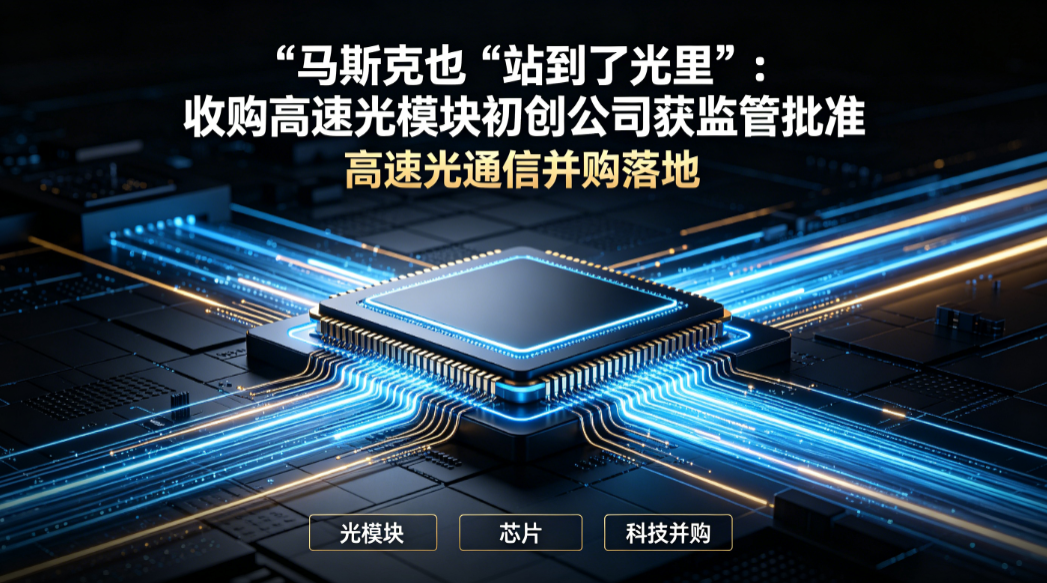
Musk 'Chasing Light': A Global Chess Game from Space to AI
Introduction
When the world's richest man, Elon Musk, extends his business empire from electric vehicles and space exploration to AI and satellite communications, a seemingly low-key acquisition is quietly changing the competitive landscape of global high-speed optical interconnect technology. On June 25, 2025, a document disclosed by the US Federal Trade Commission (FTC) revealed that Musk personally acquired high-speed optical module startup Mesh Optical Technologies, with regulatory approval finalized. This news, like a deep-water bomb thrown into the tech industry, has aroused widespread attention on this billionaire's strategic layout of AI infrastructure.
From Starlink to Data Centers: Technology Commonality and Talent Connection
The founding background of Mesh Optical Technologies has deep ties with SpaceX. This startup, founded in 2025, was co-founded by three former SpaceX engineers—Travis Brashears, Cameron Ramos, and Serena Grown-Haeberli. All three were deeply involved in the development of Starlink's satellite laser communication system at SpaceX, and this experience gave them core technology and engineering expertise in high-speed optical communications.
In February this year, Mesh Optical ended its stealth mode, announcing a $50 million Series A round led by Thrive Capital. The company clearly set its direction toward high-speed optical communication products for AI data centers, reflecting the founding team's ambition to 'descend' aerospace communication technology for commercial data centers.
Notably, the FTC filing shows the acquirer is Musk personally, not SpaceX. This detail suggests the transaction may go beyond a single business unit's strategy, but rather an important part of Musk's overall business ecosystem.
High-Speed Optical Modules: 'Nerves and Blood Vessels' of AI Infrastructure
As AI model scales continue to expand, a single data center often requires tens of thousands of GPUs for collaborative computing. In this context, data exchange speed between GPUs is becoming a key bottleneck affecting model training efficiency. High-speed optical transceivers, as core components for data transmission between servers, switches, and GPU clusters, are increasingly important.
Mesh Optical's high-speed optical transceivers use optical signals for data transmission between data center servers, offering significant performance advantages over traditional electrical connections—lower power consumption and shorter latency. These characteristics make them naturally suitable for high-intensity computing scenarios like AI data centers.
Currently, with AI investment heating up, high-speed optical modules such as 800G and 1.6T are already in short supply. Leaders like NVIDIA and Broadcom are strengthening their layouts in related fields. Musk's entry at this time is both a strategic capture of core AI infrastructure links and a precise prediction of future optical interconnect trends.
Strategic Depth: Supply Chain Autonomy and Ecosystem Closure
From a broader perspective, this acquisition reflects Musk systematically building a full-chain AI infrastructure layout from chips to communications, from ground to space. Mesh Optical's technology can serve not only ground AI data centers but also, given the founding team's experience in Starlink laser communications, opens the possibility of applying high-speed optical interconnect technology to satellite communication systems in the future.
Analysts point out that if the transaction is completed, Mesh Optical could not only provide key interconnect technology for Musk's future AI infrastructure but, more importantly, enhance the autonomy and controllability of his supply chain. Over the past few years, from self-developed AI chips and building computing clusters to continuously expanding the Starlink satellite network, Musk has been committed to reducing reliance on external key technologies. Incorporating high-speed optical communications into his own system helps reduce future procurement risks and improve software-hardware co-optimization capability.
Conclusion
Musk's acquisition of Mesh Optical, on the surface, is a technology deal about high-speed optical modules, but it actually reflects the tech mogul's deep thinking about the future AI infrastructure landscape. From Starlink satellite laser communications to data center high-speed optical interconnects, from ground AI clusters to space communication networks, a panoramic technology map spanning Earth and space is slowly unfolding.
Although specific deal details—including acquisition amount, closing time, and subsequent equity arrangements—have not been fully disclosed, it is foreseeable that with the final completion of this transaction, Musk will gain key technological capabilities in core AI infrastructure links. As the global AI race intensifies, this world's richest man's 'chasing light' journey may be the prelude to the next wave of technological change.

Disclaimer: This article is for reference only and does not constitute investment advice. Investment involves risks, please invest cautiously.
Related Reading
Hong Kong-Listed Shipping Companies' Quarterly Report Analysis: Q3 Earnings Disclosure Window Opens — Four Key Dimensions to Break Down Shipping Stocks' Earnings Quality
2026-10-26
Hong Kong Stock Individual Stock Volatility Analysis: In-depth Analysis of Capital Flow Towards Hot Sectors in September 2026
2026-09-28
BDI Index Reaches New High, Shipping Sector in Hong Kong Stocks Leads Rally, In-depth Analysis of Investment Opportunities
2026-08-19