US Stocks Diverge: Micron Earnings Ignite AI Storage Wave, Macro Tensions Simmer
US Stocks Diverge: Micron Earnings Ignite AI Storage Wave, Macro Tensions Simmer
Introduction
On Wednesday, US stocks showed significant divergence: tech stocks dragged down Nasdaq and S&P 500, while the Dow Jones Industrial Average rose against the trend, boosted by falling energy prices and a stronger aviation sector. At close, the Dow rose 182.06 points to 51,848.90, up 0.35%; the Nasdaq Composite fell 0.43% to 25,476.64; the S&P 500 edged down 0.10% to 7,358.22. Beneath the calm surface, multiple structural forces are fiercely competing—the AI wave driving storage chip demand explosion, capital revaluation from macro policy shift expectations, and commodity price volatility from geopolitical easing—together forming the complex picture of current US stocks.
1. Micron's Earnings 'Explode': The Golden Age of AI Storage Chips
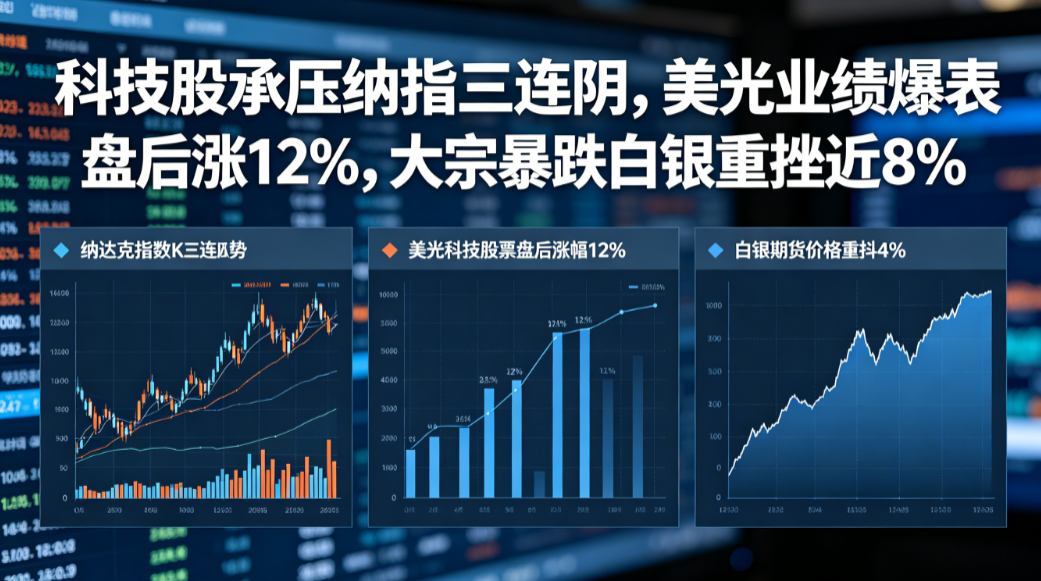
Micron Technology's third fiscal quarter 2026 earnings report, released Wednesday after hours, became the most attention-grabbing market event. Benefiting from strong AI demand for storage chips, all core metrics beat market expectations: total revenue reached $41.46 billion, soaring 346% from $9.3 billion a year ago, far above analyst estimates of $35.84 billion; gross margin jumped from 39% to 84.9%; net profit surged from $1.89 billion to $28.24 billion; adjusted EPS was $25.11, significantly above consensus of $20.78.
By segment, data center business became the strongest engine: revenue grew over 7 times to $11.5 billion; cloud storage revenue surged over 300% to $13.77 billion; mobile and PC client revenue grew over 250% to $11.52 billion; automotive and embedded storage revenue quadrupled to $4.63 billion. This comprehensive earnings explosion fundamentally reflects the rigid demand for storage components from AI infrastructure construction—as tech giants like NVIDIA and Google continue expanding AI training and inference cluster scales, demand for high-bandwidth memory (HBM) and SSDs in their processors grows exponentially. Micron, as a core hardware supplier, stands at the forefront of this super cycle.
Micron CEO Sanjay Mehrotra stated in official remarks: 'With AI demand across all tracks and long-term structural capacity constraints on the supply side, we judge the chip tight balance will continue beyond calendar 2027.' This judgment is not unfounded—over the past two years, AI chips have consumed all capacity of the world's few storage manufacturers, chip prices have soared, Micron's stock has surged about 700% over the past year, and the company's market cap exceeds $1 trillion. The company's Q4 revenue guidance is about $50 billion (vs. $11.3 billion last year), adjusted EPS guidance range $30-32, both well above expectations, and capex guidance up to $100 billion, showcasing management's strong confidence in the industry outlook.
2. Tech Stock Divergence: Valuation Repairs and Capex Concerns
Despite Micron's impressive results, the overall tech sector remains sluggish. Among star tech stocks, only Amazon edged up 0.11%, Google fell 0.30%, Tesla and Microsoft both fell over 1%. The Philadelphia Semiconductor Index fell 0.31%, Qualcomm fell 3.29%, Intel fell 0.48%, among storage chip stocks, Seagate fell 4.30%, Western Digital fell 4.01%, Micron closed down 0.31% after a late-session rally.
Since this week, the Nasdaq 100 index has lost over $1 trillion in market value. Market sentiment is pressured by two main bearish factors: first, hyperscale cloud vendors are heavily investing in AI infrastructure through debt, raising concerns about capital efficiency—while capital flows to hardware suppliers driving their earnings, the cloud vendors themselves face profit pressure; second, investors increasingly bet on the Fed's hawkish policy shift, with high interest rates systematically suppressing growth stock valuations.
Founder ETF partner Michael Monaghan summarized the market contradiction: 'The AI capex boom is diverging: capital chases computing hardware suppliers but sells cloud vendors that heavily invest in infrastructure.' RGA Investment CIO Rick Gardner noted: 'This tech pullback is a healthy consolidation; most tech stocks were overvalued before. The market gradually realizes that earnings expectations have been raised high, making it harder for companies to meet targets in the July earnings season. This decline is essentially a recalibration of earnings expectations.' This observation contrasts sharply with Micron's earnings—in the AI era, companies that truly master core hardware supply enjoy certain growth, while cloud vendors relying on AI application monetization face more complex profit challenges.
3. Macro Policy & Economic Data: Market Waits for Key Signals
On the economic data front, US May new home sales fell to an annualized 580,000, down 6.8% year-on-year, far below expectations. However, Oxford Economics believes this is only a temporary low, and based on expectations of lower mortgage rates, home sales may recover by year-end. The data reinforced concerns about economic slowdown but did not change expectations of the Fed's hawkish stance.
The Fed's annual stress test released Wednesday showed that all 32 tested banks, under a severe recession scenario simulating unemployment surging to 10%, commercial real estate prices falling 39%, and residential home prices falling 30%, saw their core Tier 1 capital ratios decline 1.6 percentage points but still well above regulatory minimums, with total potential losses absorbable exceeding $708 billion. Fed Vice Chair for Supervision Bowman commented: 'Today's results reaffirm the resilience of the banking system.' This result helps stabilize financial sector confidence.
The market's most watched variable is the US May Personal Consumption Expenditures (PCE) price index due Thursday—the Fed's preferred inflation gauge. The CME FedWatch tool shows traders expect the Fed to complete a second rate hike by end of December. Under this expectation, medium- and long-term Treasury yields fell across the board: 10-year yield fell 9.8 bps to 4.40%, 2-year yield fell 6.1 bps to 4.136%. Yield curve changes reflect the market still digesting uncertainty around inflation and interest rate paths.
4. Commodity Market: Geopolitical Easing and Commodity Sell-off
International commodity markets experienced sharp volatility. With signs of easing in the Middle East, more oil tankers are expected to exit the Strait of Hormuz, driving international oil prices to new lows since the Iran conflict. NY crude futures fell 3.92% to $70.34/barrel, Brent crude fell 4.33% to $73.74/barrel. US Secretary of State Rubio confirmed that US-Iran technical talks will resume in Switzerland at the end of the month and said the US will not harm the security of Gulf allies, further reducing geopolitical risk premium.
The energy sector was under pressure across the board, with the State Street energy ETF falling over 1%, and majors like ExxonMobil and Chevron falling over 2%. In contrast, United Airlines surged 7.40% as UBS named it a top pick for Q2 earnings, and sectors benefiting from low oil prices like aviation and tourism attracted capital.
Precious metals also suffered heavy losses: COMEX gold futures fell 3.38% to $3,990.30/oz, silver futures plunged 7.7% to $57.68/oz, with intraday losses exceeding 10%. A stronger dollar was the main factor suppressing precious metals, while rising expectations of Fed rate hikes also weakened gold's safe-haven appeal. Industrial metals also performed poorly, with LME aluminum and tin falling over 4%, copper and nickel falling over 2%, reflecting uncertainty about the global economic recovery.
5. Conclusion and Outlook
Current US stock market is at a critical turning point: the battle between AI-driven structural bull market and traditional macro cyclical pressures is intensifying. On one hand, AI hardware companies like Micron are seeing explosive earnings growth, confirming the reshaping of the underlying logic of the tech industry; on the other hand, concerns over high valuations, tightening interest rates, and cloud vendor capital efficiency are triggering systematic adjustments.
Looking ahead, three dimensions need attention: first, PCE data will determine whether market pricing of the Fed's monetary policy path is reasonable; second, in the July earnings season, whether AI hardware companies can continue to beat expectations and whether cloud vendor profit guidance can stabilize will deeply affect sector confidence; finally, the evolution of Middle East geopolitical tensions and commodity price trends will impact inflation and growth expectations, thereby influencing monetary policy decisions. The structural divergence in US stocks may continue—real Alpha will belong to those quality targets that can occupy a hardcore supply position in the AI wave while maintaining earnings resilience amid macro disturbances.

Disclaimer: This article is for reference only and does not constitute investment advice. Investment involves risks, please invest cautiously.
Related Reading

Hong Kong-Listed Shipping Companies' Quarterly Report Analysis: Q3 Earnings Disclosure Window Opens — Four Key Dimensions to Break Down Shipping Stocks' Earnings Quality
2026-10-26
Hong Kong Stock Individual Stock Volatility Analysis: In-depth Analysis of Capital Flow Towards Hot Sectors in September 2026
2026-09-28
BDI Index Reaches New High, Shipping Sector in Hong Kong Stocks Leads Rally, In-depth Analysis of Investment Opportunities
2026-08-19