Helen's brand-trademark final invalidation triggers a sharp market-cap drop; young consumers are no longer buying in
Helen's market cap plunges after final trademark invalidation; young consumers are no longer buying in
Helen's loses its Chinese trademark; court rules invalid in final judgment
Have you been to Helen's? The Chinese bar chain known as "young people's first bar" has recently lost its Chinese name. The Chinese trademarks "Helen's," "Helen's Bar," and "Helen's Bigger Food Stall" were all ruled invalid by the court in the final judgment.
According to reports, the trademark dispute mainly arose between Chengdu Helen Binfeng Hotel Co., Ltd. and Helen's. The other party successfully registered two "Helen" trademarks in 2016 under Class 43 hotel and bar services, and on May 23, 2023 filed an invalidation request against the "Helen's" trademark, and on August 7, 2024 against the trademarks "Helen's Bar" and "Helen's Bigger Food Stall," with the China National Intellectual Property Administration.
After three years of back-and-forth, on the evening of June 25, Helen's announced that the above three Chinese trademarks had been ruled invalid in the final judgment. The announcement said that, based on the current assessment, the dispute has no material impact on the group's overall business, daily operations, or financial position, and the group can continue using its undisputed trademarks in day-to-day business.
Reporters found that as of now, its offline stores and online promotions are still using Chinese expressions such as "Helen's." The impact has not yet reached individual stores, but the capital market is more sensitive.
After the announcement, the stock opened lower on June 26 and once fell more than 6% intraday. By the close, Helen's stock price fell to HK$1.58. Public information shows that Helen's market value once reached HK$30 billion in its IPO year, but now it is only HK$2 billion, a drop of more than 90%.


"Young people's first bar" is no longer young: expansion through value-for-money now under profit pressure
Helen's was founded in 2009, originally in a secluded storefront in Beijing's Wudaokou, near Tsinghua and Peking Universities. Founder Xu Bingzhong once said the early business mainly targeted foreigners, such as overseas students.
Perhaps related to that, Helen's originally used English trademarks like "Helen's" and applied for a batch of related English trademarks in 2013, but its core Chinese trademarks were not registered until 2018, laying the groundwork for the trademark crisis that followed.
In positioning, Helen's later rebranded itself as "a space for free offline communication for young people" and emphasized "ultimate value for money." Bottled beer was priced below RMB 10, while cocktails were a bit more expensive but mostly still in the low RMB 20s.
The "young people + value for money" model was replicated. According to the prospectus, by the end of 2021 Helen's had 782 stores and went public on the Hong Kong market under the halo of "the largest bar chain in China."
The prospectus showed revenue of RMB 115 million, RMB 565 million, and RMB 818 million in 2018, 2019, and 2020, respectively, with net profits of RMB 9.734 million, RMB 79.136 million, and RMB 70.072 million. Even though drink prices were low, that did not mean the business wasn't profitable.
The prospectus disclosed that Helen's own-label drinks, with gross margins above 70%, contributed more than 60% of beverage revenue. Thanks to factory direct sourcing and economies of scale, third-party branded drinks also enjoyed relatively favorable purchase prices.


One advantage was scale. But expansion brought soaring opening costs, plus the impact of the pandemic and other factors, leading to a net loss of RMB 230 million in 2021; the loss widened to RMB 1.601 billion the following year.
After cumulative losses exceeded RMB 1.8 billion, Helen's began closing stores to save itself. Financial reports showed that by the end of 2023 the group had 479 bars, down 288 from a year earlier and more than 40% below the peak of over 850.
At the same time, Helen's launched a strategic shift from fully self-operated to open franchising — the "Hi Beer Partners" plan. When it launched, the minimum investment threshold was already starting at RMB 600,000; by 2024, the threshold for the new store format had been reduced to around RMB 400,000.

The turnaround is showing results, but pressure remains: same-store declines and a more segmented competitive scene
The turnaround measures have improved things to some extent. According to the 2025 annual report, Helen's full-year revenue was RMB 540 million, down 28.3% year on year; net profit attributable to shareholders was RMB 33.954 million, successfully turning a loss into a profit. The share of self-owned beverage revenue and gross profit margin both improved year on year, and store-level gross margin rose to 73.77%, with overall operating conditions better than the previous year.
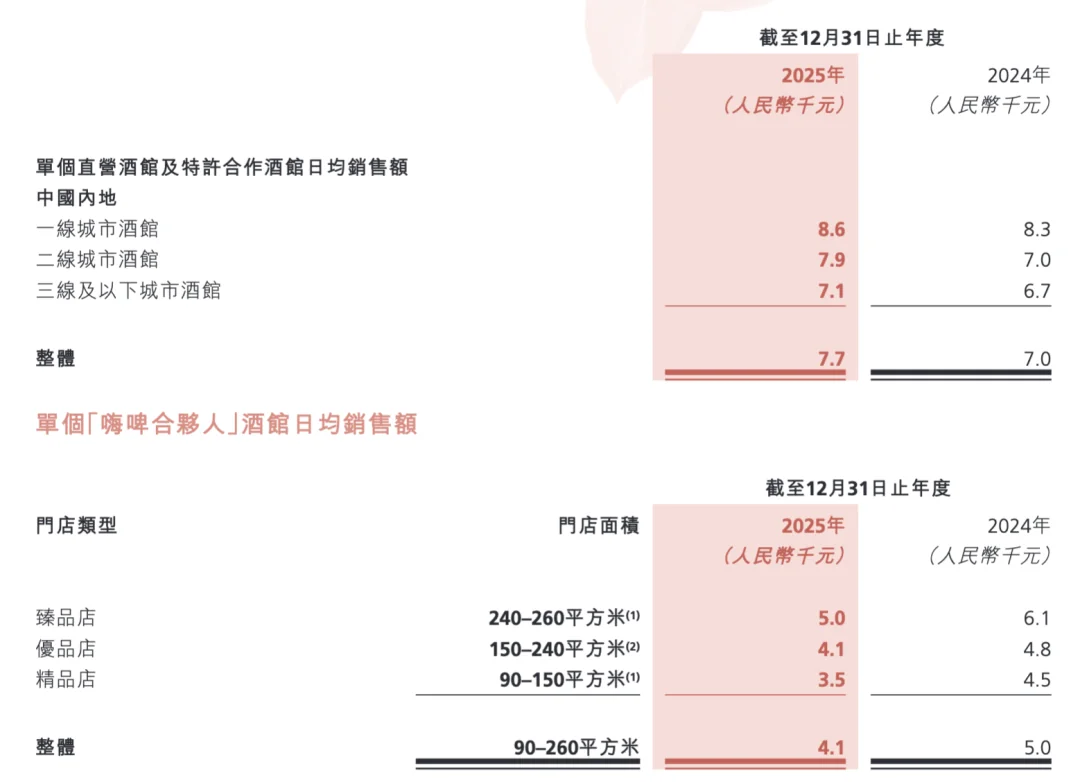
But single-store operations are still declining. In 2025, the average daily sales for same stores in directly operated and franchised cooperative stores was RMB 8,500, down more than 18% year on year; the average daily sales for a single partner store was only RMB 4,100. Average daily sales fell across all store types.
In a restaurant market where single-store daily revenue often exceeds RMB 10,000, Helen's main franchise model looks relatively weak in per-store revenue. In addition, nearly 70% of Helen's stores are in third-tier cities and below, putting pressure on profitability.

Meanwhile, consumers have more drinking and socializing options, and the attractiveness of low prices is weakening. According to Jiandian Analysis, 38,000 new bars opened over the past year. Consumption scenes have expanded from home bars, craft-beer bars, and livehouse-style bars to all kinds of bistros, further diversifying the market.
Among them, bistros that combine food and alcohol have risen strongly in recent years. Within this segment, Huanshi, which operates a food-plus-alcohol model, is growing rapidly. Public information shows that Huanshi's parent company, Jiwu Thinking, filed a prospectus with the Hong Kong Stock Exchange in January this year. Huanshi now has more than 100 stores in China, and the company's revenue exceeded RMB 1 billion in 2024.
Compared with Helen's, which won the market through low prices and scale, Huanshi has taken a different path. Its environment emphasizes ambiance, and per-capita spending is above RMB 100. On social media, one of the impressions people have of Huanshi is "pretty food." The prospectus disclosed that its average daily sales per store were RMB 29,880 in the first nine months of 2025.
Huanshi extends its operating hours to more than 18 hours by offering brunch, afternoon tea, dinner, and late-night drinks, improving store utilization and operating efficiency. The prospectus disclosed that in the first nine months of 2025, alcoholic and nonalcoholic drinks contributed about 45% of revenue, of which 85% was alcoholic beverages; gross margin for the period remained stable at 68.7%, above the industry average.
However, Huanshi also faces pressure from store costs and reputation. High store costs squeeze profits, and consumer complaints about taste and quality can damage the brand.
Food industry analyst Zhu Danpeng believes that, like the coffee sector, low-, mid-, and high-end brands each have their own market. The same is true for bars. The bar segment is in a period of rapid expansion, but overall concentration is still low. Perhaps after another five years, with capital support and consumption dividends, the market will see leading brands and a clearer competitive landscape.
He also pointed out that the hard factors determining the future of the bar business include brand effect, scale effect, fan effect, supply-chain completeness, and single-store operating capability. Because each store is in a different location, strategies also need to be differentiated. For Helen's, running every store well may be the biggest challenge.
Disclaimer: This article is for reference only and does not constitute investment advice. Investment involves risks, please invest cautiously.
Related Reading

港股即时看:油运股旺季窗口开启,VLCC运价、油价结构与盘面联动的三线盯盘法
2026-10-28
Hong Kong Stocks Live: Frequent Intraday Swings in Shipping Stocks — A Triple Verification Framework to Help You Identify Real Breakouts vs. Fake Rallies
2026-10-27
Hong Kong Stock Instant View: Why are Hong Kong Stocks the "Slow Variables" on the Shipping Chain? Full Analysis of Three Monitoring Signals and Allocation Logic
2026-10-23